
How ABA Therapy for Autism Supports Children’s Growth and Development
ABA Therapy for Autism Supports Child Development
Children with autism often face challenges in communication, managing emotions, and handling everyday tasks. These difficulties can affect school, friendships, and family life, leaving parents looking for practical ways to help their child succeed. ABA therapy for autism provides a structured approach that helps children learn meaningful skills one step at a time.
ABA therapy focuses on careful observation, breaking skills into small, teachable steps, and reinforcing progress consistently. Decisions about what to practice next are based on real results, not guesswork, giving children a predictable and supportive environment for learning.
This blog explains how ABA therapy supports communication, emotional regulation, and independence. It also shows how farm-based ABA programs give children hands-on experiences such as caring for animals and participating in farm routines. These real-life activities help children apply skills outside the therapy session. Families can see what a typical session looks like, how goals guide growth, and how progress is tracked to ensure the skills learned are practical and lasting.
What Is the Foundation of ABA?
ABA stands for applied behaviour analysis. If you have ever wondered what ABA therapy for autism is, the answer is simple. It is a method that studies how behaviour works and how learning happens. It uses structured strategies to teach communication, social, academic, and daily living skills. Key features include:
Clear and Measurable Goals
Each skill has a specific target, so everyone knows what the child is working toward.
Examples include asking for help, following a two-step instruction, or completing a task independently.
Clear goals make progress easy to see and give children chances to celebrate small successes.
Consistent Reinforcement
Positive feedback, like praise, stickers, or small rewards, shows children which behaviours are correct.
Encourages children to try again and build confidence.
Helps children learn new skills steadily and feel motivated to practice.
Tracking Progress
Therapists watch and record how children respond and how often they succeed at tasks.
This information helps adjust activities to match the child’s needs.
Tracking ensures learning is effective and that skills are improving over time.
Individualized Programming
Every child has a plan designed for their strengths, challenges, and pace of learning.
Activities are tailored to what the child needs most, rather than using a one-size-fits-all approach.
Individualized programs make learning more meaningful and help children succeed in real-life situations.
ABA does not rely on one-size-fits-all plans. Every child’s strengths, needs, and pace of learning are taken into account. At Horse Therapy Centre of Canada, ABA principles are applied in farm-based and experiential settings. Structured programs are designed to support children in real-world environments, including interacting with horses and participating in farm routines. This approach helps skills transfer beyond a clinic setting while focusing on measurable growth in a calm and respectful learning space.
The Science Behind Behaviour Analysis and Autism
Understanding behaviour analysis and autism helps families see why consistent support matters. behaviour analysis looks at how actions are influenced by the environment. It studies what happens before a behaviour, the behaviour itself, and what happens afterward. These patterns guide how new skills are taught.
Children with autism often benefit from predictable teaching methods. When skills are broken into clear steps and practiced consistently, learning becomes easier. Over time, children can improve communication, focus, and self-regulation.
Early Intensive behavioural Intervention
Early, intensive behavioural intervention has been shown to support cognitive development and daily living skills in young children with autism. Reichow et al. (2012) highlight that consistent, structured teaching helps children reach meaningful milestones in communication and independence.
Broad Application Across Skills
ABA strategies are effective across many areas, including communication, social skills, and daily functioning. Structured teaching methods can be adapted to help children improve a wide range of practical skills (Gitimoghaddam et al., 2022).
Improvements in behavioural Outcomes
Children receiving structured ABA-based interventions have shown measurable improvements in behaviour. Rafiee and Khanjani (2019) emphasize that careful observation, consistent reinforcement, and individualized planning are key to helping children manage challenges effectively.
Through this approach, Horse Therapy Centre of Canada uses evidence-based principles in its programs. Behavioural goals are clearly defined and tracked over time, while farm-based, hands-on activities give children opportunities to practice skills in real-world settings. This makes it easier for children to apply what they learn to everyday life

How Individualized Goals Support Growth in ABA Therapy for Autism
Every child learns differently, which is why individualized planning is key in ABA therapy for autism. Before therapy begins, a detailed assessment identifies each child’s strengths, areas for growth, communication skills, and behavioural patterns.
From this assessment, clear, measurable goals are set. These may include:
Improving spoken or alternative communication
Reducing challenging behaviours
Building attention and completing tasks
Strengthening self-help skills
Developing positive peer interactions
Communication Development
Communication is often a main focus. Children may learn to request items, express feelings, or answer questions. Skills may start with simple words and gradually progress to full sentences or conversations. Practicing these skills in real-life activities, like interacting with others or guiding horses, helps make communication more natural and functional.
Behaviour Regulation
Emotional regulation can be challenging. ABA strategies help children learn replacement behaviours. For example, instead of crying when frustrated, a child may be taught to ask for help or take a break. Positive reinforcement encourages these new skills.
Everyday Independence
Daily living skills are another important focus. Children practice tasks like dressing, brushing teeth, and following routines. Learning these skills helps build confidence and independence. With repeated practice, children can apply these skills more consistently in their daily lives.
Farm-based ABA therapy lets children practice skills in real-life settings. At Horse Therapy Centre of Canada, children can learn while grooming horses, helping with farm tasks, or joining guided activities. These hands-on experiences make learning practical and meaningful, and progress is tracked to make sure goals stay realistic and supportive of each child’s growth.
What Happens in an ABA Therapy Session for Autism
Parents often want to know what a typical ABA therapy session for autism looks like. While each session is tailored to a child’s goals, there is usually a clear structure that guides learning.
Sessions typically include:
Warm-up activities to prepare the child for learning
Direct teaching of specific skills
Practice through repetition
Applying skills in real-life situations
Recording progress and observations
Therapists give prompts when needed and gradually reduce support as the child becomes more independent. Positive reinforcement, such as praise, preferred activities, or small rewards, encourages progress. Over time, external reinforcement is reduced as the child internalizes the skills.
Structured but Flexible
ABA sessions have a clear structure, but they are not rigid. If a child is tired, upset, or overwhelmed, the therapist adjusts the activities. The focus is on steady progress and building skills at the child’s own pace. Sessions aim to support learning without creating pressure.
Learning in Real Environments
Skills are practiced in different settings so children can use them outside therapy. For example, a child who learns to ask for help during a session should also be able to do the same at home or school. Practicing in real situations helps make learning practical and meaningful. It supports children in applying skills across their daily routines.
Farm-based ABA therapy combines structured teaching with hands-on learning. At Horse Therapy Centre of Canada, children practice skills like communication while leading a horse or completing multi-step barn tasks. These activities give natural, meaningful ways to apply what they learn. Progress is tracked carefully, and programs are adjusted to support each child’s growth in everyday life.
Understanding ABA Therapy Techniques for Autism
ABA therapy for autism uses clear, planned strategies chosen to match each child’s learning style and goals. These methods help children build skills gradually in ways that make learning easier to understand and practice.
Discrete Trial Training
Skills are broken down into small, easy-to-follow steps and taught one at a time. Each practice includes a clear instruction, the child’s response, and immediate feedback. This method allows children to focus on one skill at a time, making it easier to learn and remember. Repeating these short steps helps build confidence and mastery before moving on to more complex skills.
Natural Environment Teaching
Skills are taught during everyday activities so learning feels meaningful and practical. For example, asking for a toy during playtime can become a teaching moment for communication. This approach helps children use new skills in real situations, which makes it easier to apply them outside of therapy sessions. Learning in natural settings also helps children stay engaged and motivated.
Task Analysis
Complex tasks are broken into simple, manageable steps to make them easier to learn. For instance, brushing teeth can be divided into picking up the toothbrush, applying toothpaste, brushing each section, and rinsing. Teaching each step separately helps children understand the full task without feeling overwhelmed. Gradually, they can put all the steps together independently.
Positive Reinforcement
Positive feedback is used to encourage children to repeat behaviours you want to see more often. This can include praise, a small reward, or access to a favorite activity. Reinforcement is most effective when it is meaningful to the child. Over time, it helps children build confidence and motivation while learning new skills in a positive, supportive way.
ABA is not about forcing children to follow instructions. Instead, it focuses on building independence and helping them manage frustration. At Horse Therapy Centre of Canada, farm-based ABA therapy applies these step-by-step techniques alongside hands-on activities. As a result, children practice real-life skills such as sequencing, responsibility, and communication, with sessions tailored to their comfort and progress tracked to ensure learning is practical and meaningful.
Is ABA Therapy Only for Autism?
ABA therapy is often thought of as a tool just for autism, but it is not limited to that. While it is widely used to support children and teens with autism, helping with communication, behaviour, and daily living skills, its principles can also benefit individuals with other developmental or behavioural challenges. The method focuses on teaching skills step by step and reinforcing progress to help participants gain independence in practical ways.
ABA strategies are flexible and can be applied in schools, behavioural support programs, or other skill-building settings. The aim is always to meet each individual’s needs while respecting their strengths and pace of learning. Consistent guidance and measurable goals help participants practice skills in ways that are meaningful and achievable.
Adding hands-on, real-world activities makes ABA even more effective. At Horse Therapy Centre of Canada, children and teens with autism or other developmental needs participate in farm-based ABA therapy, combining ABA strategies with practical activities like caring for horses and completing farm tasks. Sessions are tailored, supervised, and designed to help skills, such as communication, sequencing, and responsibility, carry over into everyday life, making learning both engaging and practical.
Measuring Progress in ABA Therapy for Autism
A key part of ABA therapy for autism is tracking measurable progress. During sessions, therapists collect data to see how often a behaviour happens, how long it lasts, or whether a new skill has been learned.
This tracking is important because it shows whether the strategies are helping. If progress slows or stops, the plan can be adjusted based on what the data shows.
Progress may look like:
Communicating more naturally
Fewer challenging behaviours
Better task completion
Increased independence in daily routines
Growth usually happens step by step, with small improvements adding up over time. Farm-based ABA therapy programs at Horse Therapy Centre of Canada use clear records for every session. Families get regular updates on goals and progress. This careful tracking keeps programs effective, transparent, and personalized, helping children use their skills in everyday life.
Farm-Based ABA Therapy and Experiential Learning
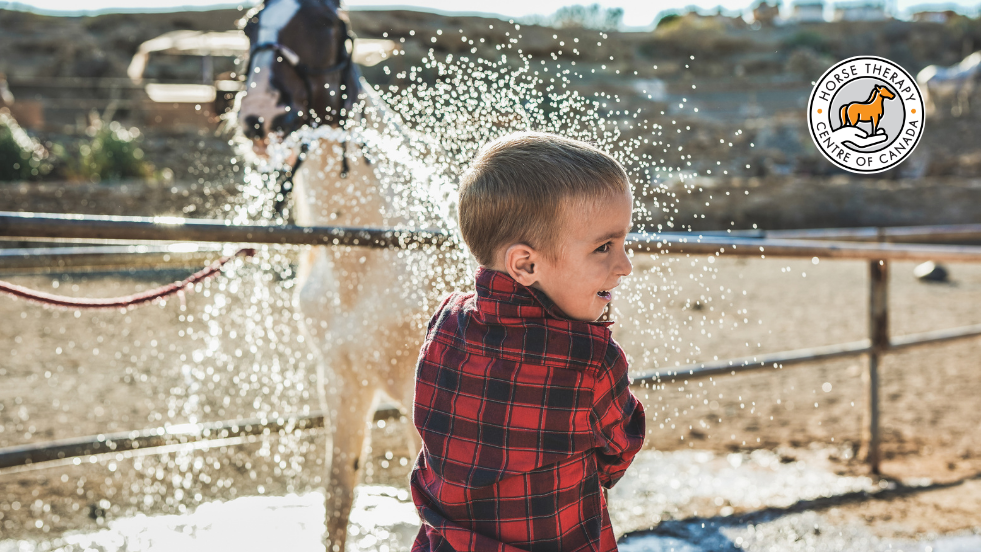
Learning doesn’t only happen in a clinic or classroom. Farm-based ABA therapy lets children practice skills outdoors while doing hands-on activities. Working with animals and moving around can help children pay attention and stay motivated.
In these programs, children learn to:
Follow step-by-step directions
Control their movements
Communicate clearly
Handle changes between activities
Take responsibility for tasks
Learning by doing helps children connect what they are taught to real-life situations. At Horse Therapy Centre of Canada, ABA methods are combined with activities around horses and nature. Children practice skills in a safe, supervised environment, with guidance and support throughout each activity. This approach helps children apply what they learn to everyday life while building confidence and independence.
FAQs about ABA therapy for autism
What is ABA therapy for autism, and how does it work?
ABA therapy is a step-by-step approach that helps children learn important skills. It uses clear goals and positive feedback to teach communication, behaviour control, and independence. Progress is tracked carefully, and programs are adjusted based on what the data shows. This ensures learning is effective and tailored to each child’s needs. Programs at Horse Therapy Centre of Canada follow these principles to support consistent, measurable growth.
How long does an ABA therapy session for autism usually last?
The length of sessions depends on the child’s age and the program’s intensity. Some sessions last one to two hours, while intensive programs may include multiple sessions per week. Each session at Horse Therapy Centre of Canada are designed to match each child’s needs and attention span, ensuring learning stays productive without being overwhelming.
Are ABA therapy techniques for autism effective for communication delays?
Yes. When ABA strategies are used consistently, many children improve their communication skills. Techniques like breaking tasks into steps and practicing skills during everyday activities help build functional language over time. Horse Therapy Centre of Canada integrates these strategies into farm-based programs to give children meaningful opportunities to practice communication in real-world situations.
Is ABA therapy only for autism, or can it help other conditions?
ABA principles can help children with a range of behavioural or developmental challenges. It is most commonly structured for autism because it targets communication, behaviour, and daily living skills. At Horse Therapy Centre of Canada, programs can be adapted to support other needs while still following the same step-by-step methods.
How is progress measured in ABA therapy for autism?
Progress is tracked during every session using clear, measurable data. This may include new skills learned, fewer challenging behaviours, or increased independence. Therapists use this information to adjust teaching strategies and make sure goals remain realistic and achievable. Horse Therapy Centre of Canada monitors progress carefully to ensure each child is supported and learning goals remain meaningful.
For More Information
If you would like to explore related topics, these Horse Therapy Centre of Canada blog posts may be helpful:
Effective Parenting Tips: Raising Happy and Healthy Children with Equine Assisted Therapy
Empowering Neurodiverse Individuals Through Equine-Assisted Therapy
Nurturing Confidence: Parenting Techniques for Children and Teens with Social Anxiety
Finding Harmony: Equine Therapy for Life Balance and Fulfillment
These articles provide additional insight into equine-assisted approaches, professional pathways, and experiential learning models.
References
Reichow, B., Barton, E. E., Boyd, B. A., & Hume, K. (2012). Early intensive behavioural intervention for young children with autism spectrum disorders. Cochrane Database of Systematic Reviews. https://doi.org/10.1002/14651858.CD009260.pub2
Gitimoghaddam, M., Chichkine, N., McArthur, L., Sangha, S. S., & Symington, V. (2022). Applied behaviour analysis in children and youth with autism spectrum disorders: A scoping review. Perspectives on behaviour Science, 45(3), 521–557. https://pmc.ncbi.nlm.nih.gov/articles/PMC9458805/
Rafiee, S., & Khanjani, Z. (2019). The effectiveness of applied behaviour analysis therapy in children with autism spectrum. International Journal of Multicultural and Multireligious Understanding, 6(6), 750–769. https://ijmmu.com/index.php/ijmmu/article/view/1225
Plan Your Child’s Farm-Based ABA Therapy with HTCC
Supporting a child’s growth can feel challenging, but farm-based ABA therapy for autism provides a hands-on way to build important skills. Children learn at their own pace, and practicing skills through real-life activities makes learning meaningful and engaging.
Programs at Horse Therapy Centre of Canada combine ABA principles with guided farm activities in a safe, supportive environment. Clear goals and consistent reinforcement help children practice communication, self-regulation, and independence in ways that carry over into daily life. Contact HTCC to learn more and see if this approach could be a good fit for your child.