Emotional Control Gets Easier With Hands-On Equine Therapy
Emotional Regulation with the Support of Equine Therapy
Strong emotions are part of everyday life. Stress, frustration, anxiety, or anger can appear quickly and sometimes feel difficult to manage. For many people, learning how to recognize emotional triggers and respond calmly takes time and practice. Traditional talk therapy helps people understand their emotions, but understanding alone does not always translate into real-life regulation. Hands-on practice is often needed to turn that awareness into real-world skills, which is why experiential approaches, like equine therapy, can be especially helpful.
This is where experiential therapy with horses can help. Working with horses puts people in a hands-on environment where emotions appear naturally, and participants can practice responding in real time. Horses react immediately to human behaviour and energy, which often reveals emotional patterns that might go unnoticed in other settings.
Horses are especially sensitive to tension and calmness. This makes them excellent partners for learning emotional awareness and regulation. By interacting with a therapy horse, participants can practice staying focused, calm, and aware, learning skills they can carry into everyday life. In this blog, the focus is on how equine therapy helps participants build emotional regulation, notice triggers, and develop practical skills through hands-on experiences.
Understanding Emotional Control in Therapy
Emotional control doesn’t mean holding feelings in or ignoring them. It means noticing your emotions, understanding what triggers them, and responding in a calm, steady way. Many people struggle not because they feel too much, but because they haven’t had chances to practice managing emotions in real situations.
In traditional therapy, emotional regulation is often discussed through talking, reflection, and strategies for understanding feelings. This helps people notice patterns and triggers. But emotional regulation is also a skill that develops best through practice, not just discussion.
Why Experiential Approaches Matter
Hands-on programs, like experiential therapy and equine assisted therapy, give participants real situations to practice emotional control. These approaches help people:
Notice emotions as they happen
Recognize physical signs of stress or tension
Practice calming responses in the moment
Build confidence in handling difficult situations
Instead of only talking about feelings, participants actively work through them. Programs at Horse Therapy Centre of Canada use this hands-on approach. Guided activities with therapy horses help participants notice emotional reactions in real time and practice responding calmly. The goal is not just awareness, but learning steady, practical responses that carry over into daily life. The structured and supportive environment allows participants to explore emotions safely while building stronger self-regulation skills.
How Equine Therapy Helps Identify Emotional Triggers
One of the unique things about equine therapy is how horses pick up on human emotions. They notice body language, tone of voice, and overall energy, so even small changes in how someone feels or acts can be seen by the horse. This makes them especially sensitive partners for learning about emotional responses.
Horses respond quickly to the way a person is feeling. If someone is anxious, frustrated, or impatient, the horse might hesitate, step back, or act cautiously. If the person approaches in a calm and steady way, the horse usually responds smoothly. These reactions give a clear, real-time view of how emotions show up.
Seeing these responses in the moment creates a natural opportunity to notice emotional triggers. Participants can reflect on what made the horse react and how their own feelings influenced the interaction. Over time, this hands-on feedback helps people better understand and manage their emotions in everyday life.
Immediate Feedback from Horses
Unlike human interactions, horses don’t interpret feelings through conversation or assumptions. Their reactions are based entirely on what they sense in the moment. This gives participants clear, real-time feedback about their emotional state, helping them notice triggers like:
Feeling rushed or impatient
Becoming frustrated when things don’t go as planned
Experiencing anxiety when unsure what to do
Losing focus when emotions increase
Through these interactions, participants can see how their emotions directly affect the therapy horse. This makes equine-assisted therapy a form of experiential therapy, where insight comes from hands-on experience rather than discussion alone.
Research shows that humans and horses often mirror each other’s emotional and physiological signals, creating a dynamic form of communication during animal-assisted therapy (Scopa et al., 2019). This means that a person’s stress, calmness, or tension can be reflected in the horse’s behaviour, providing immediate, real-world feedback about emotional states and helping participants become more aware of their own reactions.
At Horse Therapy Centre of Canada, equine therapy sessions use horses’ natural feedback to help participants notice how their emotions affect interactions. Guided by trained facilitators, participants learn to recognize triggers and respond calmly. Through repeated sessions, they build patience, awareness, and emotional regulation while gaining practical skills in a supportive, hands-on setting.
Learning Emotional Regulation Through Equine-Assisted Therapy
Recognizing emotional triggers is just the first step. The next step is learning how to manage emotional responses when those triggers appear. Equine-assisted therapy provides a hands-on environment where participants can practice this skill repeatedly.
Working with horses requires calm attention. Horses respond best to clear communication and steady body language. If a participant becomes tense or frustrated, the horse often mirrors that tension, giving immediate feedback.
Practicing Regulation in Real Time
During sessions, participants may take part in activities like:
Leading a horse through an obstacle course
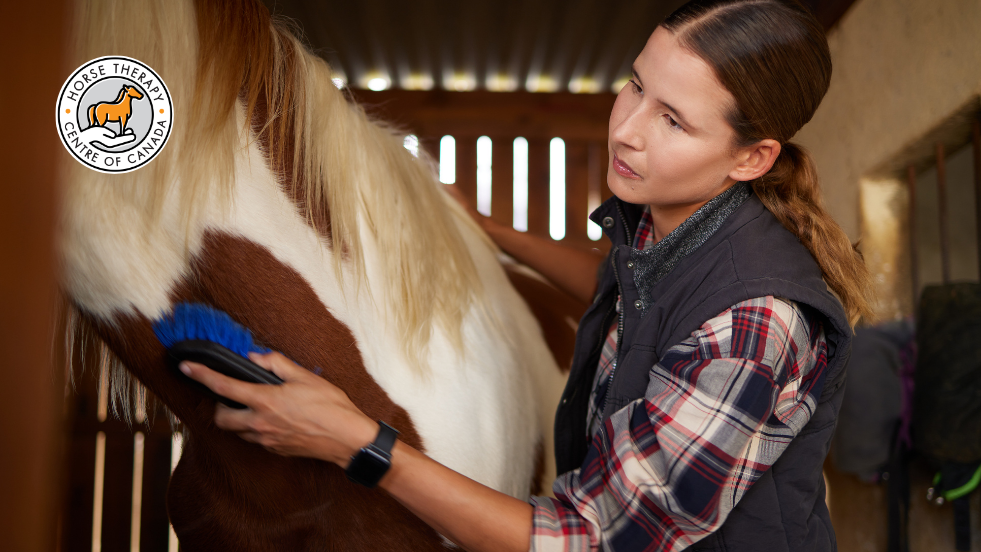
Grooming and preparing the horse
Practicing ground-based communication exercises
Observing how the horse reacts to posture or tone changes
Each activity gives opportunities for emotional reactions to appear naturally. For example, if a horse hesitates, the participant might feel frustration or self-doubt. Facilitators guide participants to slow down, notice their reactions, and practice regulating their emotions.
Strategies Learned
Through repeated practice, participants learn skills such as:
Pausing before reacting
Adjusting breathing and posture
Communicating calmly
Turning frustration into problem-solving
These moments act as practical training for emotional control.
Sessions at Horse Therapy Centre of Canada are structured to help participants practice emotional regulation safely. Guided interaction with therapy horses allows participants to build awareness while receiving support from trained professionals. The programs emphasize steady progress over quick results, and through repeated experiences, participants gradually develop stronger emotional awareness and self-control.
Why Horses Provide Unique Feedback in Holistic Therapy
Many forms of holistic therapy focus on the connection between emotional, physical, and behavioural responses. Horses naturally support this integrated approach because their communication relies heavily on nonverbal signals.
People often communicate more through posture, breathing, and tone than they realize. Horses are highly responsive to these cues, which makes them effective partners in animal-assisted therapy.
Nonverbal Communication with Horses
When interacting with horses, participants often become more aware of subtle signals such as:
Muscle tension
Breathing patterns
Body posture
Movement speed
Horses respond to these signals, showing how emotions and body state influence interactions. Research also suggests that working with horses can affect hormones like cortisol and oxytocin, which support emotional regulation and social connection (Jung et al., 2025).
At Horse Therapy Centre of Canada, equine therapy programs use this natural feedback to guide learning. Facilitators help participants notice how their emotions and body language influence the horse, helping them develop calmer, more balanced responses that carry over into everyday life.
Building Self-Control Through Repeated Experiential Therapy
Emotional regulation improves with practice. The more participants notice and manage their reactions, the easier it becomes to respond calmly in different situations. Experiential therapy works on this principle, participants learn by doing, not just talking about skills.
Gradual Skill Development
In equine-assisted therapy programs, participants often progress through stages such as:
Observation: Learning how horses communicate and respond to human cues
Awareness: Noticing their own emotional reactions during activities
Adjustment: Practicing new ways to respond when emotions arise
Confidence: Building control and consistency in interactions
This step-by-step approach helps participants feel more confident in managing emotional challenges. Research also shows that structured horse-based programs can improve emotional well-being and self-awareness (Rodríguez-Sobrino et al., 2025).
At Horse Therapy Centre of Canada, equine therapy programs are designed around this gradual learning process. Hands-on activities with therapy horses allow participants to practice emotional regulation while facilitators provide guidance and feedback at each step. With repeated practice, participants develop calmer, more controlled emotional responses that can carry over into daily life, making the skills learned both practical and lasting.
What Clients Often Notice During Animal-Assisted Therapy
People who take part in animal-assisted therapy often notice their emotions more clearly when interacting with animals. Horses, in particular, respond quickly to human behaviour, which can highlight emotional shifts that might go unnoticed in everyday life. This immediate feedback helps participants recognize patterns in how they react.
Common Observations
During sessions, participants may notice changes such as:
Increased awareness of frustration triggers
Greater patience during challenging tasks
Ability to pause before reacting
More confidence in managing emotional responses
These skills usually develop gradually through repeated practice and reflection rather than instantly.
Horse Therapy Centre of Canada supports this learning through guided equine therapy programs. Participants take part in structured activities with horses that encourage observation, reflection, and emotional regulation. By combining principles of equine-assisted therapy, experiential therapy, and holistic therapy, the programs create a safe and balanced environment where participants can build practical emotional skills that carry over beyond the session.
Frequently Asked Questions About Therapy and Emotional Regulation
How does equine therapy help with emotional control?
Equine therapy helps individuals recognize emotional reactions in real time. Horses respond quickly to human behaviour, which allows participants to see how their emotions influence the interaction. With guidance from facilitators, individuals learn how to regulate these responses and communicate more calmly. This hands-on approach is used in programs at Horse Therapy Centre of Canada, where participants practice emotional regulation in a safe, supervised setting.
Is equine-assisted therapy different from traditional therapy?
Yes. Equine-assisted therapy focuses on experiential learning through activities with horses. While traditional therapy often relies on conversation, this approach emphasizes hands-on interaction and real-time emotional awareness. At Horse Therapy Centre of Canada, programs are designed to give participants structured experiences with horses that translate into practical skills for everyday life.
Who can benefit from animal-assisted therapy with horses?
People of many ages and backgrounds can benefit from animal-assisted therapy, including individuals seeking support for stress, emotional regulation, communication skills, or personal development. Programs are usually adapted to meet the needs of each participant. Sessions at Horse Therapy Centre of Canada are tailored to individual abilities and goals to support growth and confidence.
Is holistic therapy with horses safe?
Programs are designed with safety as a priority. Horses in holistic therapy settings are carefully selected and trained, and sessions are guided by experienced facilitators who ensure safe interaction throughout. Horse Therapy Centre of Canada follows strict safety protocols, including trained staff and carefully chosen therapy horses, to make sure every session is secure and supportive.
Can therapy with horses replace other forms of therapy?
Equine-based programs are often used as complementary approaches. Many people combine equine-assisted therapy with traditional counseling or other supportive services to address emotional and behavioural goals. At Horse Therapy Centre of Canada, sessions are designed to complement other therapeutic supports, helping participants apply skills learned with horses to daily life.
Learning Emotional Balance Through Equine Therapy
Learning emotional regulation is an ongoing process that takes practice, awareness, and a safe environment. Equine therapy provides a hands-on setting where emotions naturally appear, allowing participants to notice how they feel and respond in real time. Horses give immediate, honest feedback to human behaviour, helping participants recognize emotional triggers they might not notice elsewhere.
Through repeated sessions, participants gradually develop stronger self-awareness and steadier emotional responses. Working with a horse encourages patience, focus, and calm communication, giving participants practical experience in managing their reactions. These experiences create opportunities to practice skills in a way that feels natural rather than forced.
Programs at Horse Therapy Centre of Canada are designed to support this learning step by step. Guided equine-assisted therapy sessions allow participants to explore emotional responses while receiving feedback from trained facilitators. By combining experiential learning with professional guidance, these programs help participants build lasting skills in emotional regulation, self-control, and confidence that carry over into everyday life.
For More Information
You may also find these Horse Therapy Centre of Canada articles helpful:
Stress Management Through Equine-Assisted Therapy: A Natural Path to Calm and Balance
Breaking Free from Trauma: How Equine-Assisted Therapy Restores Healing and Resilience
Finding Harmony: Equine Therapy for Life Balance and Fulfillment
Strengthening the Mind-Body Connection Through Equine-Assisted Therapy
These articles provide further insight into how equine-based programs help participants develop emotional awareness, social skills, and practical life skills in supportive, hands-on environments.
References
Scopa, C., Contalbrigo, L., Greco, A., Lanatà, A., Scilingo, E. P., Baragli, P., & Borgi, M. (2019). Emotional transfer in human–horse interaction. Animals, 9(12), 1034. https://doi.org/10.3390/ani9121034
Rodríguez-Sobrino, N., et al. (2025). Effects of equine coaching on psychoemotional well-being. Animals. https://doi.org/10.3390/ani15070905
Jung, Y., et al. (2025). The effects of human–horse interactions on oxytocin and cortisol levels. Animals, 15(7), 905. https://doi.org/10.3390/ani15070905
Explore Equine Therapy Programs
Programs at Horse Therapy Centre of Canada help participants develop emotional awareness, self-regulation, and communication skills through hands-on activities with therapy horses. The sessions take place in a safe, supportive setting where learning happens naturally and participants can engage at their own pace.
For more information or to find out which program might be a good fit, contact Horse Therapy Centre of Canada. Clear details about how sessions work and what to expect can help make an informed decision about the best approach for individual needs.